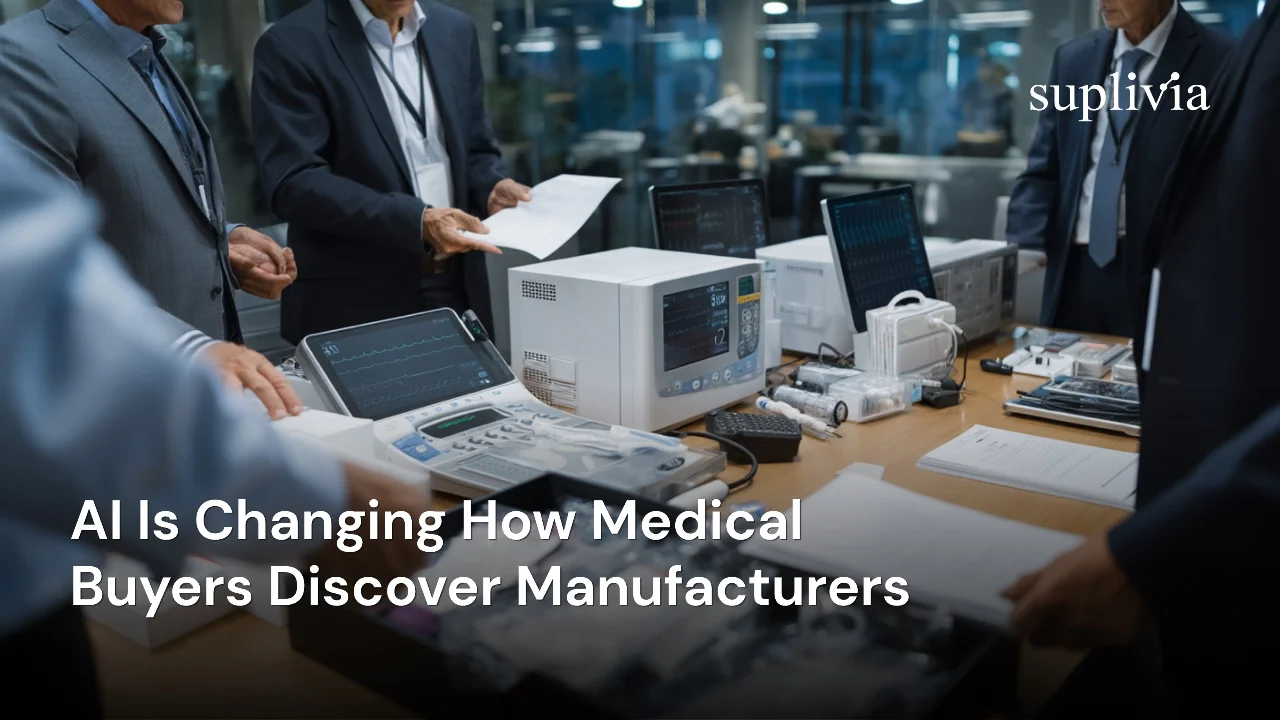
AI is changing how medical buyers discover manufacturers. For decades, procurement teams relied on trade shows, supplier directories, referrals, and manual online research to identify potential suppliers. While these methods still have value, they were built for a market with fewer suppliers, fewer products, and less data.
Today, the challenge is different. Medical buyers are no longer struggling to find suppliers. They are struggling to identify the right manufacturers quickly from thousands of potential options spread across multiple countries, product categories, and regulatory frameworks.
Why Traditional Manufacturer Discovery Is Becoming a Bottleneck
The average medical sourcing project involves far more than finding a product. Buyers must evaluate certifications, manufacturing capabilities, regulatory compliance, export experience, production capacity, and supplier reliability before initiating commercial discussions.
Traditional supplier discovery methods often require procurement teams to review dozens of websites, compare catalogs, validate certifications, and manually build supplier shortlists. This process consumes significant time and resources.
- Search engines return thousands of results with varying quality.
- Supplier directories frequently contain outdated information.
- Trade shows provide access to only a fraction of global manufacturers.
- Certification verification often requires separate research.
- Finding niche or specialized manufacturers can take days or weeks.
As healthcare supply chains become increasingly global and product requirements become more specialized, procurement teams are looking for faster ways to identify qualified suppliers.
The Shift From Search to AI-Powered Discovery
AI is transforming supplier discovery by changing how buyers search for manufacturers. Instead of relying solely on keywords, filters, and manual research, buyers can increasingly describe sourcing requirements in plain language.
Modern AI sourcing systems can interpret sourcing intent and identify relevant manufacturers based on product requirements, certifications, manufacturing capabilities, and market focus.
For example, a buyer may search for:
- CE-certified surgical instrument manufacturers in Europe
- ISO 13485 certified wound care suppliers
- Private label medical consumable manufacturers
- FDA-compliant diagnostic device producers
Rather than reviewing hundreds of supplier profiles, procurement professionals can start with a more focused shortlist of relevant manufacturers.
KEY TAKEAWAY
AI is not replacing procurement professionals. It is reducing the time spent on supplier discovery so buyers can focus on qualification, compliance, and supplier evaluation.
The broader procurement industry is already moving in this direction. According to EY's 2025 Global CPO Survey, 80% of Chief Procurement Officers plan to deploy generative AI within the next three years, while only 36% currently report meaningful implementations, highlighting significant growth potential in procurement AI adoption (EY Global CPO Survey, 2025).
Industry analysts also expect AI adoption in procurement to continue accelerating. The global AI in procurement market is projected to grow from approximately $4.25 billion in 2026 to more than $39 billion by 2035 as organizations seek greater efficiency, automation, and supplier visibility (Precedence Research, February 2026).
What AI Can and Cannot Do in Medical Sourcing
AI is highly effective at analyzing large volumes of supplier information, identifying patterns, and accelerating the creation of supplier shortlists. It can significantly reduce the manual effort required during the early stages of sourcing.
However, AI does not eliminate the need for procurement expertise.
Buyers should still verify:
- CE, ISO 13485, FDA, and other relevant certifications.
- Manufacturing capabilities and production capacity.
- Technical documentation and product specifications.
- Export experience and regulatory readiness.
- Quality management systems.
- Commercial references and track record.
Recent Gartner research highlights an important lesson for procurement leaders. While generative AI is delivering process efficiencies and improved data insights, organizations continue to face challenges related to data quality, system integration, and implementation expectations (Gartner, July 2025).
The most successful procurement teams therefore use AI to enhance decision-making rather than replace it.
The future of medical sourcing is not about searching through more suppliers. It is about discovering the right manufacturers faster.
How AI Smart Sourcing Is Reshaping Medical Procurement
AI Smart Sourcing platforms are applying these capabilities directly to manufacturer discovery. Instead of forcing buyers to navigate complex databases and supplier directories, they allow procurement teams to describe sourcing requirements in natural language and receive relevant manufacturer recommendations.
This approach helps buyers identify suppliers beyond their existing networks, discover alternative sourcing options, and reduce the time required to build qualified supplier shortlists.
For medical buyers, the opportunity is clear. AI can dramatically reduce the manual work involved in supplier discovery while improving visibility into global manufacturing markets.
Platforms such as Suplivia are applying AI Smart Sourcing specifically to medical procurement, helping buyers discover verified manufacturers through a network of more than 139,656 medical products and 10,305+ manufacturers across 80 countries. As AI adoption continues to grow across procurement functions, intelligent supplier discovery is likely to become a standard part of how medical buyers source products and evaluate new manufacturing partners.