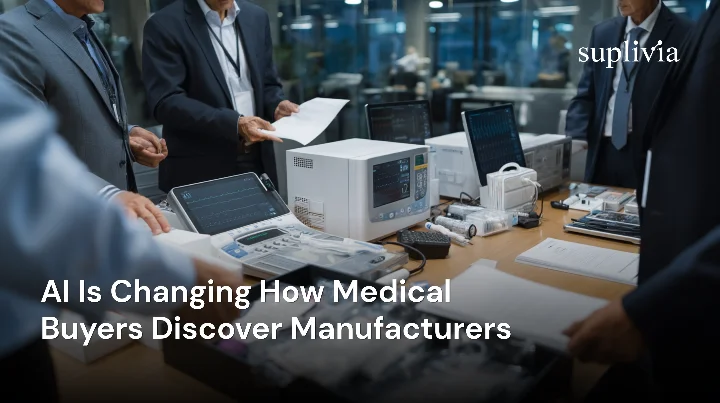
AI in medical procurement is changing how buyers discover, evaluate, and shortlist suppliers. Instead of spending hours searching directories, trade show exhibitor lists, search engines, and company websites, procurement professionals can now describe their sourcing requirements in plain language and receive relevant manufacturer recommendations within minutes. As healthcare supply chains become more global and complex, AI is helping procurement teams move from manual research to faster, data-driven supplier discovery.
Why Traditional Supplier Discovery Is No Longer Enough
Finding reliable medical manufacturers has traditionally required significant manual effort. Procurement teams often search across multiple websites, compare supplier catalogs, verify certifications, review company profiles, and contact manufacturers individually before building a shortlist.
This approach is becoming increasingly difficult as healthcare organizations seek to diversify suppliers, reduce supply chain risks, and identify manufacturing partners across multiple countries. Rather than relying on a single sourcing channel, buyers must evaluate suppliers based on product capabilities, certifications, manufacturing capacity, export experience, and regulatory compliance.
At the same time, procurement leaders are under growing pressure to shorten sourcing cycles without compromising supplier quality. Industry research shows AI adoption in procurement is accelerating, with organizations increasingly prioritizing supplier intelligence, workflow automation, and better decision-making (Deloitte Global CPO Survey, 2025; Gartner, 2025; Art of Procurement, April 2026).
How AI Changes Medical Supplier Discovery
Unlike traditional keyword searches, modern AI can understand procurement intent. Buyers no longer need to know the exact product name or manufacturer before starting a search.
Instead, a procurement manager can simply describe the requirement, such as:
"Looking for an infusion pump manufacturer in Germany with CE certification."
AI analyzes the request, understands the product category, geographic preference, and qualification requirements, then identifies manufacturers that match those criteria. This significantly reduces the amount of manual research required before supplier evaluation begins.
Modern AI-powered sourcing tools can also:
- Interpret natural language sourcing requests.
- Recommend manufacturers based on product capabilities instead of exact keywords.
- Identify similar products from alternative manufacturers.
- Support supplier diversification across multiple countries.
- Reduce time spent searching fragmented supplier databases.
- Create qualified shortlists more efficiently.
KEY TAKEAWAY
AI delivers the greatest value by eliminating repetitive supplier research. Procurement professionals still make the final sourcing decisions, but they begin with a stronger shortlist in far less time.
AI Accelerates Discovery—It Does Not Replace Due Diligence
AI should be viewed as a decision-support tool rather than a replacement for procurement expertise. Once potential suppliers have been identified, buyers must still complete a structured qualification process before requesting quotations or awarding business.
Every shortlisted manufacturer should be evaluated for:
- CE, ISO 13485, FDA, or other applicable certifications.
- Regulatory documentation and product registrations.
- Manufacturing capabilities and production capacity.
- Export experience and target markets.
- Quality management systems.
- Commercial terms and lead times.
- References and previous customer experience.
Leading procurement organizations are increasingly using AI to automate repetitive activities—including supplier discovery, specification matching, document analysis, and compliance checks—while leaving commercial evaluation and strategic supplier selection to procurement professionals (MedStrato, January 2026; Efficio, 2026).
What This Means for Medical Procurement Teams
The role of procurement is evolving from finding suppliers to evaluating the best sourcing options. As AI reduces the time spent on manual research, procurement professionals can dedicate more effort to supplier qualification, negotiation, risk management, and long-term supplier relationships.
This shift is especially valuable when organizations need alternative suppliers, enter new markets, respond to supply disruptions, or identify manufacturers with specific regulatory or production capabilities.
Platforms such as Suplivia AI Smart Sourcing demonstrate how this approach is being applied in healthcare procurement. Instead of searching by exact product names, buyers can describe what they need in plain English—for example, "Looking for an infusion pump manufacturer in Germany"—and instantly discover relevant products, verified manufacturers, and AI-matched alternatives from a global network of more than 10,000 manufacturers across 80 countries.
AI is not replacing procurement professionals. It is replacing hours of repetitive supplier research with faster, more intelligent discovery. Organizations that combine AI-powered supplier search with robust due diligence will be better positioned to build resilient supplier networks, identify qualified manufacturing partners, and make sourcing decisions with greater confidence.