EU packaging rules will change the evidence medical device buyers should request from suppliers. Regulation (EU) 2025/40 on Packaging and Packaging Waste, known as the PPWR, generally applies from 12 August 2026 and covers packaging placed on the EU market whether it is manufactured inside the Union or imported from another country (European Commission, 2026).
Average packaging waste generated per person in Europe in 2023, according to the European Commission (March 2026). :contentReference[oaicite:1]{index=1}
The PPWR does not replace the EU Medical Device Regulation or the In Vitro Diagnostic Medical Devices Regulation. Buyers must assess packaging under both frameworks: PPWR addresses packaging sustainability and waste obligations, while MDR and IVDR continue to govern device safety, labeling, traceability and sterile-barrier performance.
1. Map Every Level of Medical Device Packaging
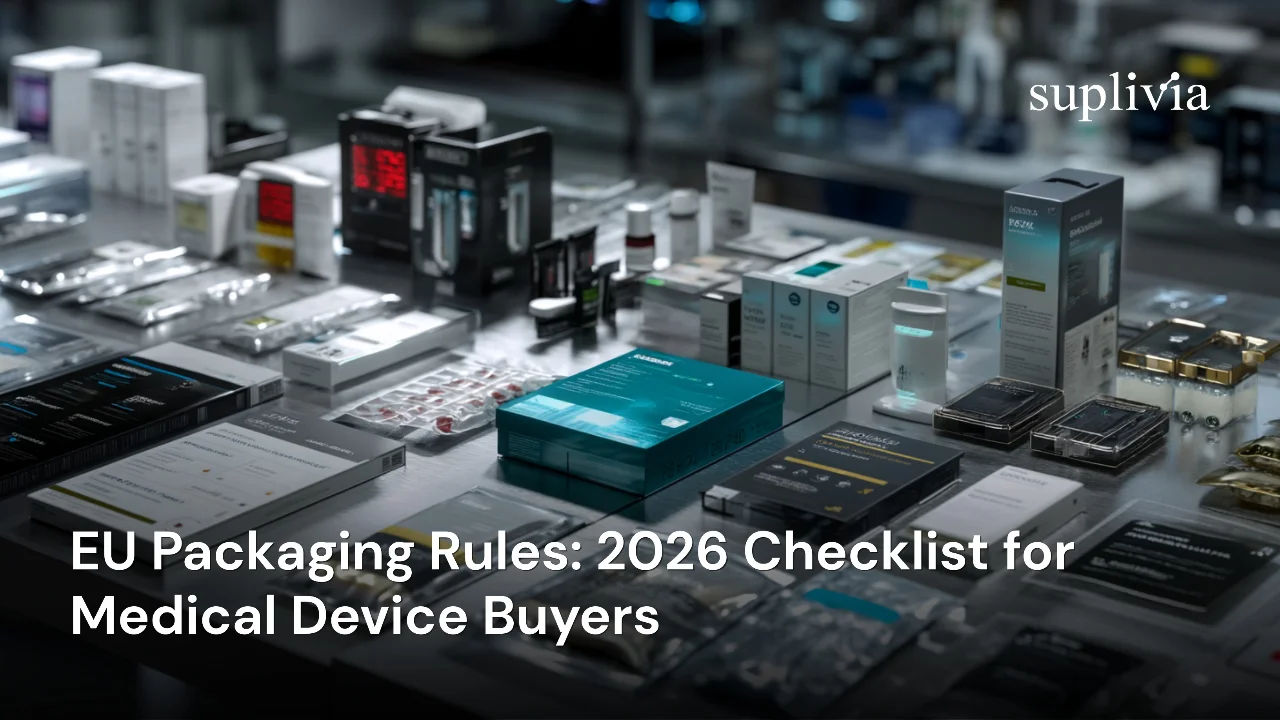
Ask the supplier to identify the immediate packaging, sales packaging, grouped packaging, transport packaging and any e-commerce packaging used for the product. Different PPWR requirements and exemptions can apply to different packaging levels.
For medical devices, the Commission’s June 2026 guidance interprets immediate packaging as the packaging in contact with the device and outer packaging as the device’s sales packaging. Procurement files should use this distinction consistently rather than treating the complete shipment as one packaging unit (European Commission, June 2026). :contentReference[oaicite:2]{index=2}
2. Request PPWR Technical Documentation
Do not rely on a supplier statement that the packaging is “eco-friendly” or “PPWR compliant.” Request the packaging technical documentation and applicable EU declaration of conformity, including the packaging specification, material breakdown, component weights, test methods and the legal entity acting as packaging manufacturer.
The PPWR assigns formal documentation duties to manufacturers, while importers and distributors must perform their own compliance checks before packaging reaches the market. Buyers should define these deliverables in the purchase order instead of requesting them after goods arrive (Regulation (EU) 2025/40). :contentReference[oaicite:3]{index=3}
3. Separate PPWR Evidence from Sterile-Barrier Validation
A thinner pouch, smaller carton or new recycled material may reduce packaging waste, but it can also affect seal strength, sterilization compatibility, shelf life or package integrity. For sterile products, require evidence that any packaging change remains covered by validated sterile-barrier and transport studies.
Ask whether the change affects the device’s risk management file, biological safety assessment, sterilization validation, stability data or notified-body documentation. Sustainability changes should never proceed as an uncontrolled packaging substitution.
4. Check Recyclability Claims and Future Deadlines
The PPWR states that packaging must be recyclable, but the detailed design-for-recycling criteria will apply later. The Commission’s 2026 guidance explains that harmonised criteria are due through delegated acts and that manufacturers will receive a transition period before the full design-for-recycling assessment applies (European Commission, June 2026). :contentReference[oaicite:4]{index=4}
Buyers should therefore ask for two things: evidence supporting the packaging’s current recyclability position and a documented roadmap for the 2030 requirements. Do not demand a final PPWR recyclability grade before the EU adopts the relevant methodology.
5. Verify Whether a Medical Packaging Exemption Applies
The PPWR includes targeted derogations for certain contact-sensitive medical device and IVD packaging. These provisions do not create a blanket exemption for cartons, transport packaging or every plastic component used around a medical device.
Require the supplier to identify the exact packaging component, PPWR article, exemption conditions and supporting evidence. A general statement such as “medical packaging is exempt” should fail the procurement review.
6. Review Packaging Labels Without Premature Changes
Buyers should not assume that every medical device package needs a new waste-sorting label in August 2026. The Commission states that the consumer sorting-label requirement does not apply to medical device and IVD packaging used only by professional end users; transport packaging is also excluded, except for e-commerce packaging (European Commission, June 2026). :contentReference[oaicite:5]{index=5}
Mandatory harmonised labels follow later implementation dates. Ask suppliers for a label-impact assessment that distinguishes device labeling required under MDR or IVDR from packaging-waste labeling under PPWR.
7. Confirm Extended Producer Responsibility Ownership
Establish who acts as the producer for packaging in each destination Member State and who will manage registration, reporting and fees. This is especially important for private-label products, direct imports and deliveries where the hospital or distributor becomes the first party to make the packaged product available nationally.
Request producer registration details where available, the responsible producer-responsibility organisation and a written allocation of EPR costs. The Commission’s March 2026 guidance addressed EPR interpretation, but national implementation and administrative arrangements still require country-level checks (European Commission, March 2026). :contentReference[oaicite:6]{index=6}
8. Add Packaging Controls to Supplier Contracts
Contracts should require advance notice before changes to packaging material, dimensions, printing, sterilization configuration or packaging suppliers. They should also allocate the cost of retesting, relabeling, non-compliant stock, EPR reporting and corrective actions.
Before approving an EU medical device supplier in 2026, obtain a packaging map, PPWR scope assessment, technical documentation, declaration of conformity, exemption rationale, EPR ownership statement and controlled-change procedure.
The most important procurement decision is not whether packaging looks sustainable. It is whether the supplier can prove compliance without weakening device protection, sterility or traceability. Buyers using Suplivia can apply the same documentation checklist when comparing verified medical manufacturers across different countries and regulatory markets.