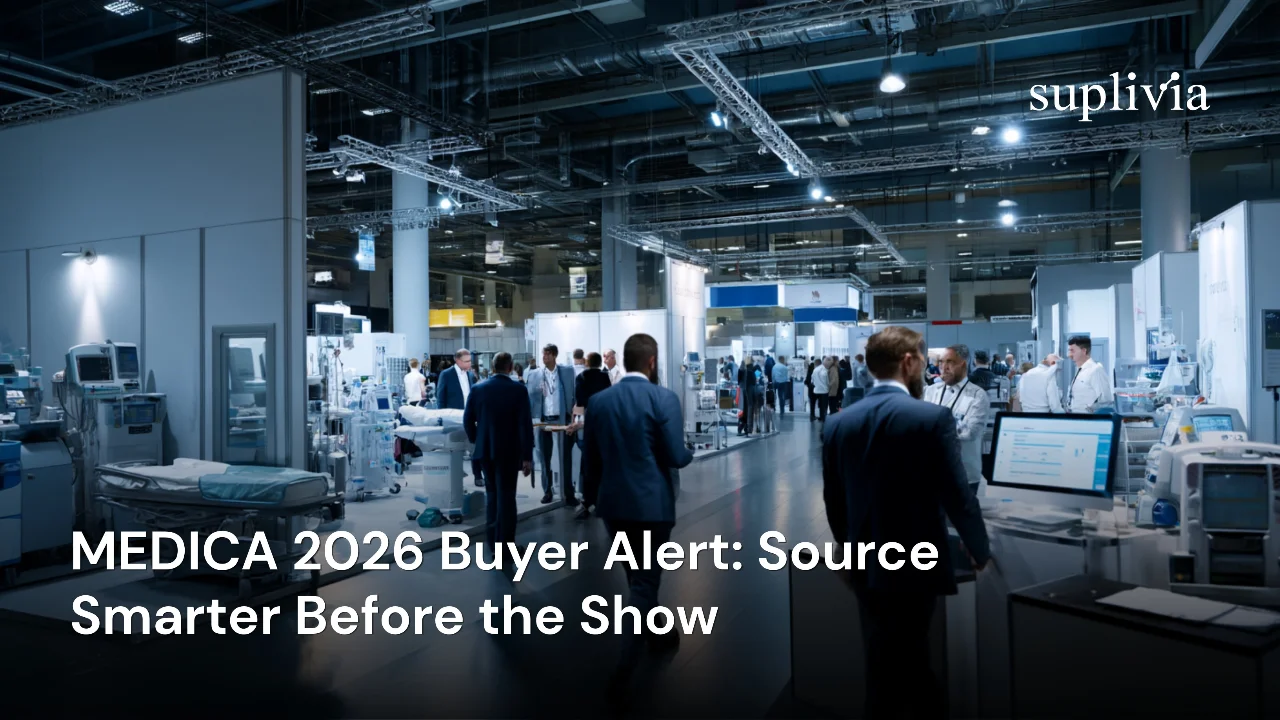
MEDICA 2026 can save months of supplier discovery—or waste four days in unqualified meetings. For medical procurement buyers, the difference will come down to preparation, supplier screening and a clear list of sourcing requirements before arriving in Düsseldorf.
MEDICA 2026 takes place from 16–19 November 2026 at Messe Düsseldorf, Germany.
The event will run from 10:00 a.m. to 6:00 p.m. from Monday to Wednesday and from 10:00 a.m. to 4:00 p.m. on Thursday (Messe Düsseldorf, July 2026).
Why MEDICA 2026 requires a new buyer strategy
MEDICA has reorganized its exhibition structure around healthcare applications and clinical needs rather than relying only on traditional product categories. The five main areas now cover clinical diagnostics and therapeutic technologies; data and artificial intelligence; integrated care, rehabilitation and home care; healthcare infrastructure; and healthcare systems, education and global health (Messe Düsseldorf, January 2026).
This structure should make it easier to compare complete solutions, but buyers may also find competing technologies distributed across broader clinical themes. Procurement teams should therefore search by both product type and intended use.
The organizer reports figures of 78,000 visitors from 165 countries, 4,821 exhibitors from 70 countries and a 75% international visitor share. Those numbers underline the sourcing opportunity, but they also make unplanned booth visits inefficient (Messe Düsseldorf, 2026).
Build a MEDICA 2026 supplier shortlist before travelling
Start with a written sourcing brief for every priority category. Include the product specification, target certification, annual volume, destination market, preferred Incoterms, acceptable lead time, packaging requirements and private-label expectations.
Use the official MEDICA 2026 exhibitor directory to identify manufacturers before the event. Separate direct manufacturers from distributors, service providers and component suppliers, then assign each company a priority level.
- Priority A: Meets the core specification and target-market compliance requirements.
- Priority B: Offers a relevant alternative product or manufacturing capability.
- Priority C: Requires further clarification before a meeting is justified.
Contact Priority A suppliers before the exhibition. Request product catalogues, certificates, declarations of conformity, manufacturing-site details and an initial commercial range. A confirmed meeting with documents reviewed in advance has more value than an unscheduled introduction at a crowded stand.
Verify more than the certificate shown at the booth
A CE mark, ISO 13485 certificate or FDA registration reference should start the due-diligence process, not complete it. Buyers should confirm the legal manufacturer’s name, certificate scope, issuing body, validity period, manufacturing address and whether the specific product under discussion appears within the relevant documentation.
Ask who owns the technical file, who performs final release, which processes are outsourced and whether the exhibitor can legally supply the destination market. Collecting these answers during the meeting reduces lengthy clarification after the show.
Buyer takeaway: Do not leave a MEDICA meeting with only a catalogue and business card. Leave with verified company details, document commitments, indicative pricing, sample terms and a dated next step.
Turn exhibition meetings into qualified sourcing decisions
Use the same scorecard for every supplier. Rate compliance, product fit, production capacity, export experience, communication, pricing transparency, lead time and willingness to provide evidence.
Send meeting notes and document requests within 48 hours. Suppliers that respond accurately and on time should move forward. Companies that avoid basic verification questions should move down the shortlist, regardless of how impressive their booth appears.
Buyers using Suplivia can pre-screen relevant manufacturers across its verified network before MEDICA 2026, compare product coverage and prepare a more focused meeting list. The platform currently covers more than 200,000 medical products from over 10,000 manufacturers across 80 countries.